
-
INDUSTRIES
-
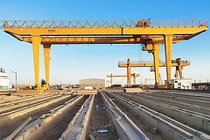
Precast Concrete Plant
-
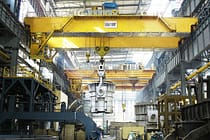
Steel Industry
-
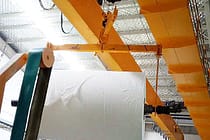
Paper Industry
-
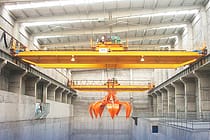
Waste to Energy and Biomass Industry
-
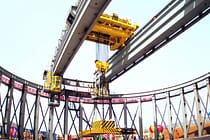
Power Industry
-
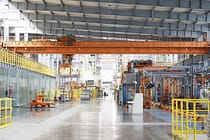
Overhead Cranes for Automotive Production: Smart Solutions for Enhanced Efficiency
-
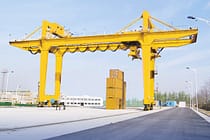
Port Machines Industry
-
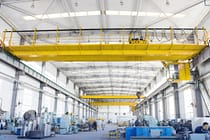
Manufacturing Industry
-
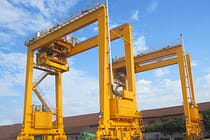
Different Types of Container Cranes, Shipyard Cranes, Cargo Cranes Used in Port, Harbor and Quay
-
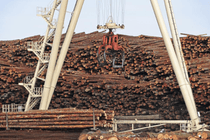
Overhead Cranes for Timber Lifting: Efficient and Safe Wood Handling
-

Overhead Cranes for the Aviation Industry: Streamlining Aircraft Assembly, Maintenance, and Repair
-

Overhead Cranes for Food and Beverages: Ideal for improving productivity and food safety
-
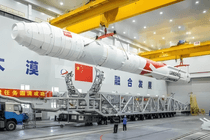
Overhead Cranes for Aerospace Industry: Key Role in Efficient Rocket Manufacturing and Launch
-
-
EQUIPMENT
-
Overhead Cranes
-
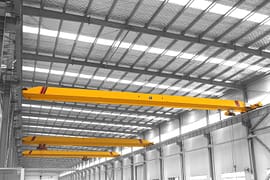
Single Girder Overhead Crane
-
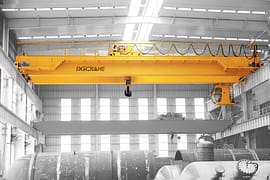
Double Girder Overhead Crane
-
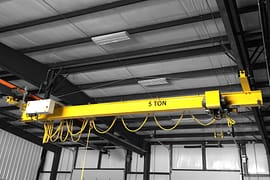
Underslung Cranes
-
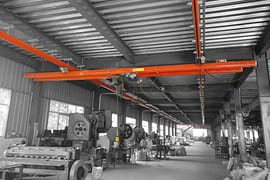
Workstation Overhead Cranes
-
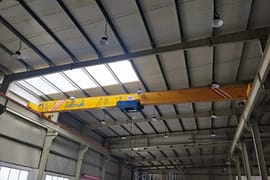
Low Headroom Overhead Cranes
-
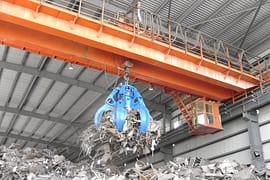
Grab Bucket Overhead Crane
-
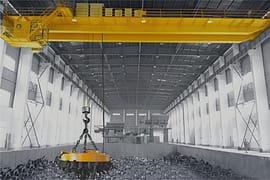
Electromagnetic Overhead Cranes with Lifting Magnet
-
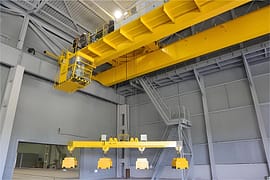
Electromagnetic Overhead Cranes with Magnet Beam
-
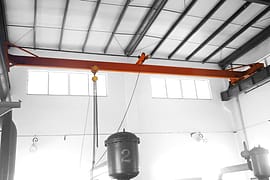
Manual Overhead Cranes
-
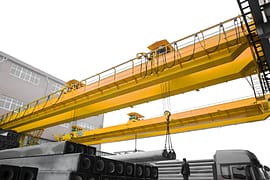
Double Trolley Overhead Cranes
-
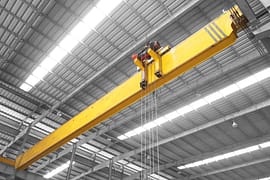
LDP Single Girder Overhead Cranes
-
- Eot Cranes
- Gantry Cranes
- Jib Cranes
- FEM Standard Crane & Hoist
- Hoist & Winch Trolley
-
Light Cranes
-
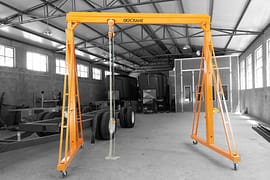
Portable Mobile Gantry Cranes
-
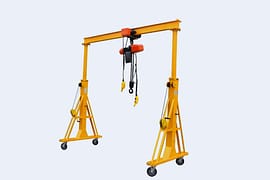
Adjustable Gantry Cranes
-
Aluminum Gantry Crane
-
Foldable Aluminum Gantry Crane
-
Monorail Overhead Cranes
-
Workstation Jib Cranes
-
Electric Hoists
-
Workstation Overhead Cranes
-
Freestanding Workstation Bridge Crane
-
Ceiling Mounted Workstation Bridge Crane
-
Manual Portable Gantry Crane
-
Multi-point Suspension Cranes
-
- Explosion Proof Cranes and Hoists
-
Special Cranes
-
35-65t Clamp Overhead Crane
-
Boat Hoists
-
Boat Jib Crane
-
Yacht Davit Crane
-
Rail Mounted Container Gantry Crane
-
Cleanroom Overhead Cranes
-
YZ Ladle Handling Cranes
-
LDY Metallurgical Single Girder Crane
-
Charging Cranes for Steel Production
-
Insulated Overhead Cranes
-
Gantry Crane for Subway and Metro Construction
-
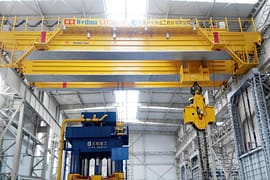
Forging Crane
-
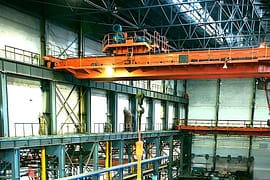
Quenching Overhead Crane
-
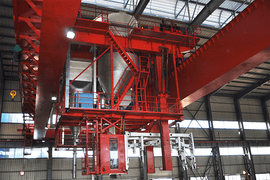
Baking Multifunctional Crane
-
- Port Cranes
- Electric Transfer Carts
-
Overhead Cranes
-
CRANE PARTS
- Crane Wheel Range
- Crane Spreader
- Crane Drives
-
Crane Electrical Equipment
-
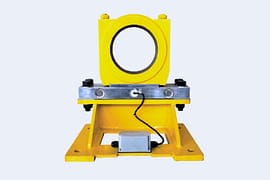
Overload Limiter
-
Crane Cabin
-
Crane Power Supply System
-

Explosion Proof Crane Radio Remote Controls
-
Joystick Type Crane Radio Remote Controls
-
Pushbutton Type Crane Wireless Remote Controls
-
Single-pole Insulated Conductor Rails
-
Enclosed Conductor Rails
-
Seamless Conductor Rails
-
Copperhead Conductor Rails
-
Overhead Crane Cables
-
- Other Cranes Parts
\
- ABOUT US
- CONTACT US

Workstation jib cranes: Essential things you need to know
Table of Contents
What are workstation jib cranes?
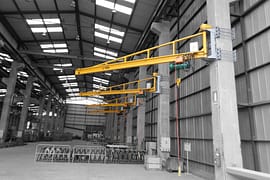
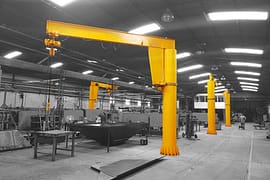
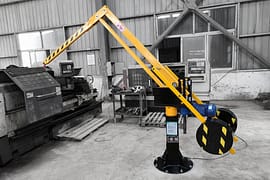
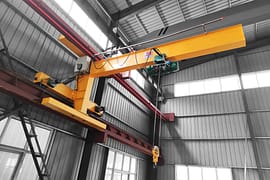
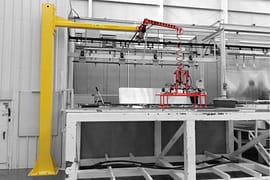
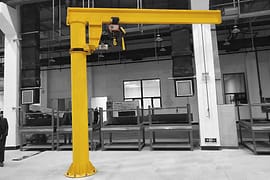
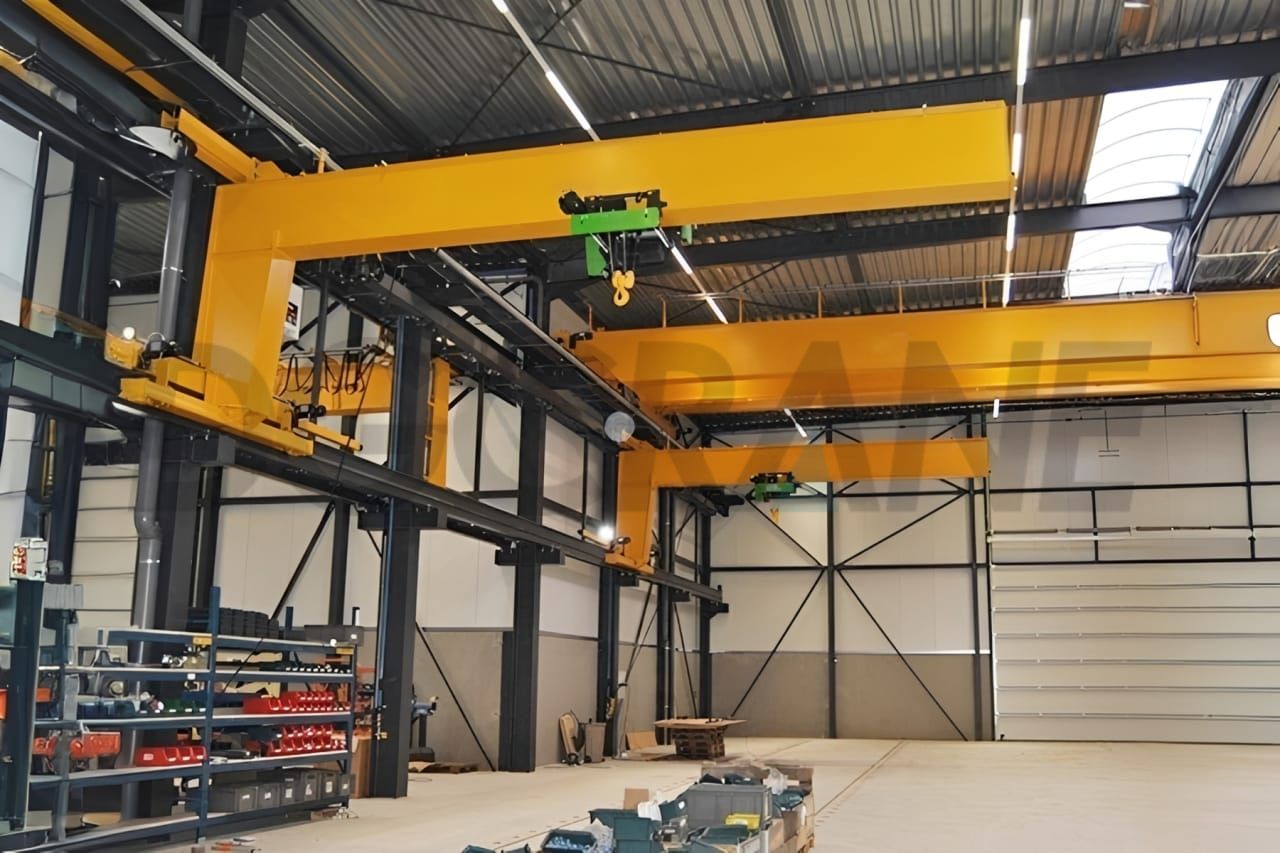
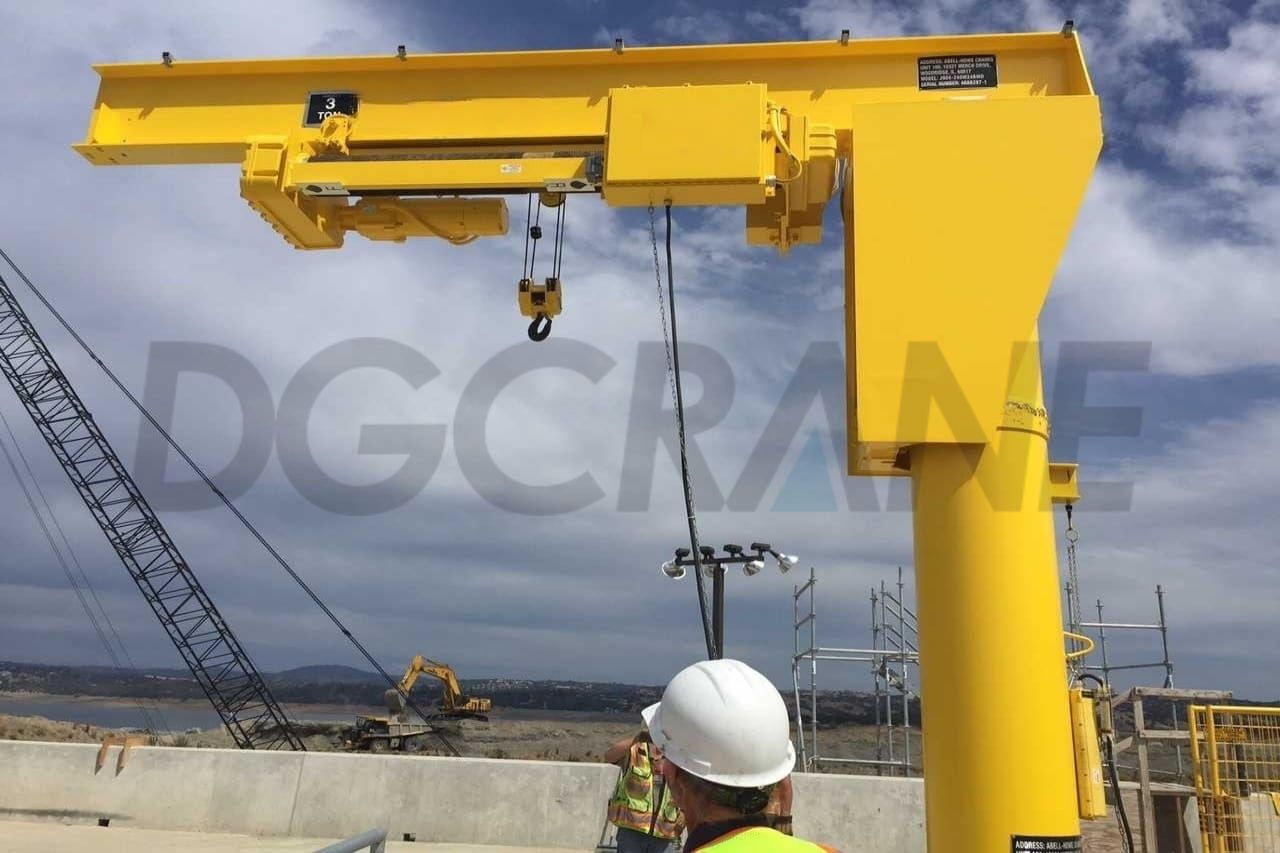
Workstation jib cranes are lightweight, compact boom-type lifting devices specifically designed for scenarios such as individual workstations or designated workshop units. They offer greater flexibility in application and provide improved ergonomics compared to traditional jib cranes. Mountable on walls or floors, they can also be moved with a movable base, making them ideal for short-distance, high-frequency, and intensive lifting operations.
Capable of three-dimensional material handling via chain hoists or lifting trolleys, it features agile rotation, minimal footprint, and expansive operational space. When wall-mounted, it rotates up to 180 degrees; when floor-mounted, it rotates up to 360 degrees.
What are the components of a workstation jib crane?

- Pillar: The vertical steel columns used to support the entire equipment are fixed to the concrete ground at their lower ends with anchor bolts; if the workstation jib crane is wall-mounted, its pillar will be served by the wall or factory building columns.
- Horizontal jib: A rotating arm extending horizontally from the column, capable of rotating up to 360°.
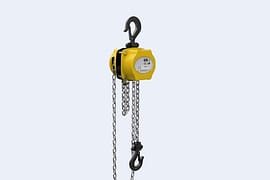
- Chain hoist: The core component of a jib crane, enabling the vertical lifting of loads via chain slings or wire ropes.
- Trolley: Horizontal movement along cantilever tracks enhances flexibility in positioning heavy loads.
- Rotating mechanism: Composed of a series of bearings or bushings, enabling the cantilever to rotate horizontally with precision.
- The handle: Simply press a button to raise, lower, or stop the load. The handle sends signals to the crane, allowing for safer control without needing to be near the load.
What are the features of a workstation jib crane?
- Ergonomic operations reduce workers’ fatigue.
- Simple and convenient installation. Floor-mounted units are typically installed directly onto the concrete floor using chemical anchor bolts; wall-mounted units are commonly secured with through bolts or clamps.
- Compact design, ideal for limited or confined spaces.
- The low requirements for application scenarios enable seamless integration into existing environments.
- Low-maintenance and purchase cost.
In which industries can workstation jib cranes be used?
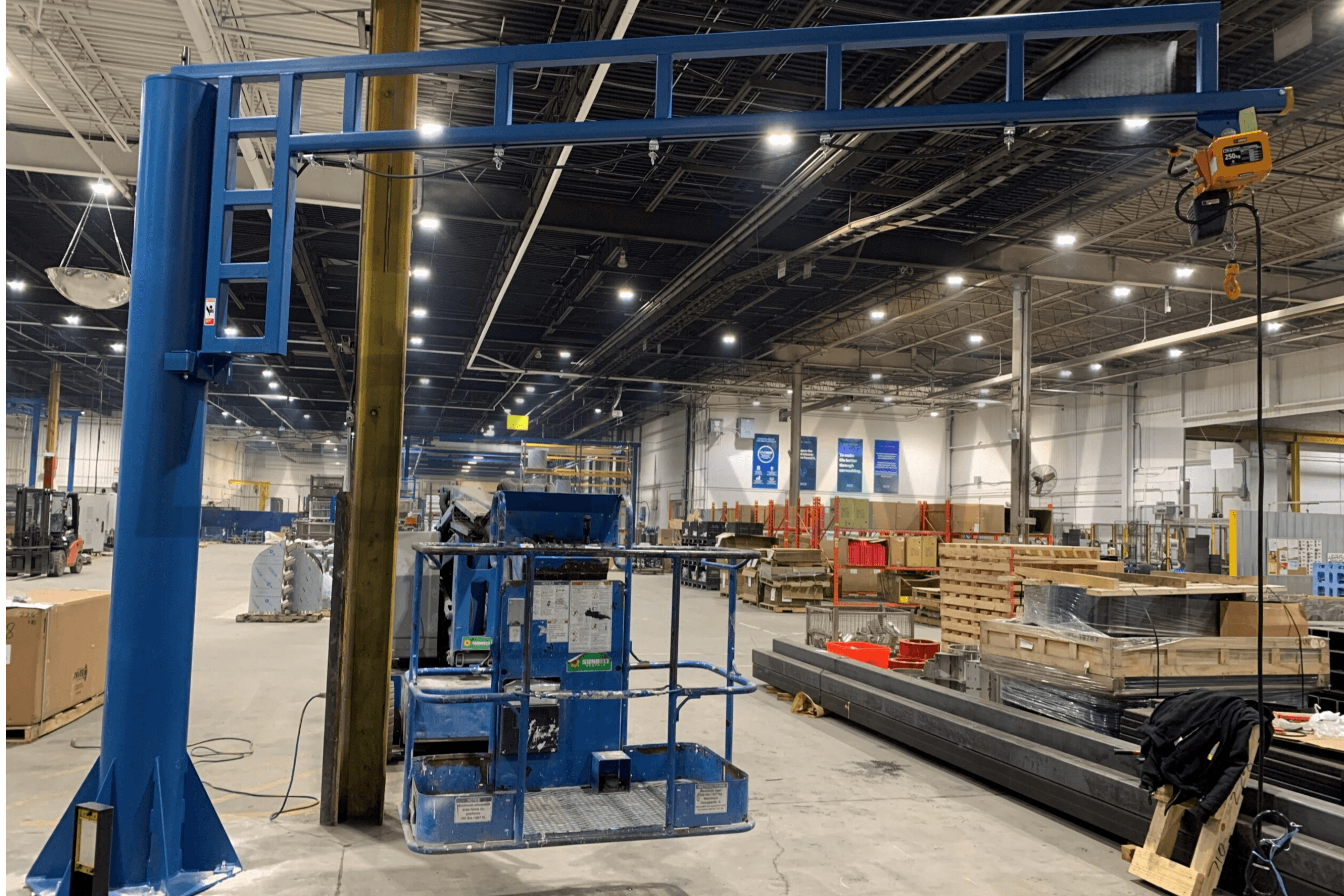
Automotive components manufacturing industry
Automotive manufacturing production lines are characterized by high precision and labor-intensive assembly tasks, demanding speed, accuracy, and frequent operations. Workstation jib cranes provide support for assembling engine blocks, transmissions, and other automotive components. Mounted alongside production line stations, these jib cranes enable effortless and precise component assembly, reducing worker fatigue while minimizing errors caused by repetitive, strenuous tasks. They are fully adaptable to the compact layouts and confined spaces typical of assembly shops or field installations.
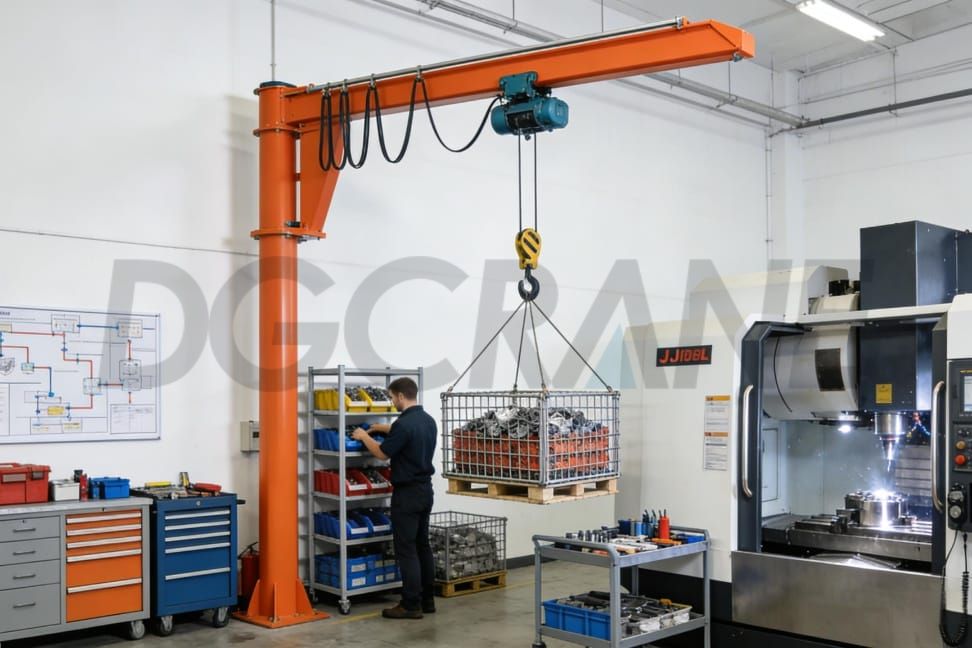
Mechanical processing industry
Machine processing refers to the use of machinery, technology, and mechanical principles to manufacture high-precision mechanical parts and components that meet technical specifications. This involves processing a series of equipment such as lathes, milling machines, drilling machines, and other devices to produce finished parts. When equipment or manufactured components are excessively heavy or require precise installation, cantilever cranes provide targeted solutions to these challenges while eliminating the difficulties and time consumption associated with manual alignment. Simultaneously, the flexibility of cantilever cranes ensures both efficiency and quality in production lines.
Food and beverage industries
These industries typically feature high humidity and strict foreign object control requirements. Therefore, whether for raw material feeding, finished product packaging, or maintenance and cleaning of molds and conveyor belts, cantilever cranes enable flexible and efficient material handling while ensuring contamination-free production of food or beverages.

Pharmaceutical industry
Biopharmaceutical or drug formulation production typically occurs in cleanrooms, where strict control over airborne particulate levels (dust) is maintained. Many pharmaceutical reactor vessels feature extremely heavy lids equipped with precision sensors, necessitating the use of jib cranes for smooth lifting during cleaning or maintenance. Additionally, jib cranes are employed for centrifuge loading/unloading and material handling, and their stability and safety ensure uninterrupted pharmaceutical production.

Warehousing and logistics industries
With the rapid development of e-commerce, the warehousing and logistics industry has grown increasingly vital. Companies strive to store more goods in smaller spaces while ensuring precise transportation. Consequently, workstation jib cranes are commonly deployed at loading docks, warehousing centers, and palletizing/de-palletizing zones to transfer or sort bulk heavy components, wooden crates, oversized express packages, and similar cargo. In high-density warehouse environments, wall-mounted cranes prove particularly practical within spatial blind spots or areas restricted to forklifts. Their streamlined operation facilitates rapid order fulfillment and reduces inventory holding times.
Wind power and the energy industries
Offshore wind farms, pump rooms in hydroelectric power stations, and nacelles of onshore wind turbines represent precision operation zones within the wind power and energy sector that operate under extreme conditions. These environments are characterized by severely restricted space, harsh conditions, stringent safety requirements, and exceptionally high maintenance costs. As an indispensable auxiliary tool, the cantilever crane offers full rotational flexibility even in confined spaces, enabling obstacle avoidance. Its compact design maximizes effective lifting height within extremely low ceilings or cabins.
Summary
In summary, the workstation jib crane is an efficient, flexible, and economical material handling solution tailored for modern high-efficiency production environments. With its compact structure, outstanding ergonomic design, and perfect adaptability to confined spaces, it has become the ideal choice for enhancing operational efficiency at specific workstations and reducing worker labor intensity. Across all industries, it delivers maximum operating radius and lifting height within minimal floor space constraints, making it an indispensable asset in modern industrial production. DGCRANE continues to provide workstation jib cranes that excel in performance, efficiency, durability, safety, reliability, and innovative intelligence—meeting the diverse demands of contemporary industrial applications.

Zora Zhao
Expert in Overhead Crane/Gantry Crane/Jib Crane/Crane Parts Solutions
With 10+ years of experience in the Crane Overseas Export Industry, helped 10,000+ customers with their pre-sales questions and concerns, if you have any related needs, please feel free to contact me!
WhatsApp: +86 189 3735 0200
Email: zorazhao@dgcrane.com
Contact Details
DGCRANE is committed to providing the professional Overhead crane products and relavent service. Exported to Over 100 Countries, 5000+ Customers Choose Us, Worth to be Trusted.
Get In Touch
Fill out your details and someone from our sales team will get back to you within 24 hours!