


-
INDUSTRIES
-

Precast Concrete Plant
-
Steel Industry
-
Paper Industry
-
Waste to Energy and Biomass Industry
-
Power Industry
-
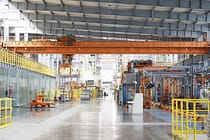
Overhead Cranes for Automotive Production: Smart Solutions for Enhanced Efficiency
-
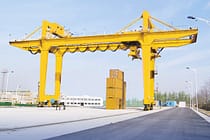
Port Machines Industry
-

Manufacturing Industry
-
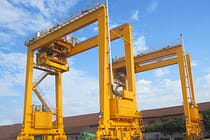
Different Types of Container Cranes, Shipyard Cranes, Cargo Cranes Used in Port, Harbor and Quay
-
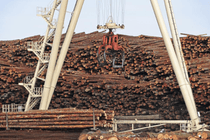
Overhead Cranes for Timber Lifting: Efficient and Safe Wood Handling
-

Overhead Cranes for the Aviation Industry: Streamlining Aircraft Assembly, Maintenance, and Repair
-

Overhead Cranes for Food and Beverages: Ideal for improving productivity and food safety
-
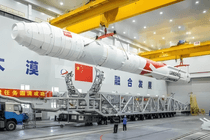
Overhead Cranes for Aerospace Industry: Key Role in Efficient Rocket Manufacturing and Launch
-
-
EQUIPMENT
-
Overhead Cranes
-
Single Girder Overhead Crane
-
Double Girder Overhead Crane
-
FEM Standard Overhead Cranes
-
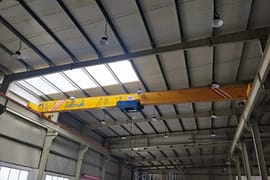
Low Headroom Overhead Cranes
-
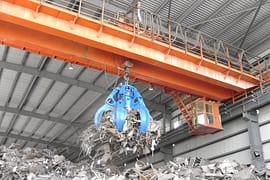
Grab Bucket Overhead Crane
-
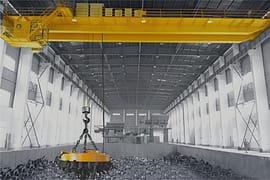
Electromagnetic Overhead Cranes with Lifting Magnet
-
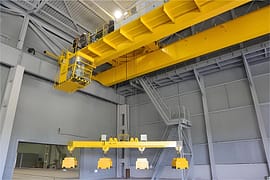
Electromagnetic Overhead Cranes with Magnet Beam
-
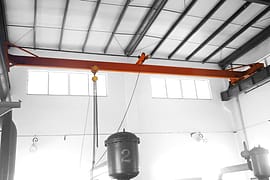
Manual Overhead Cranes
-
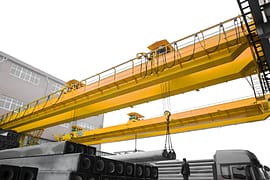
Double Trolley Overhead Cranes
-
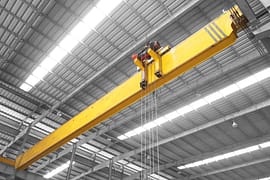
LDP Single Girder Overhead Cranes
-
- Eot Cranes
- Gantry Cranes
- Jib Cranes
-
Hoist & Winch Trolley
-
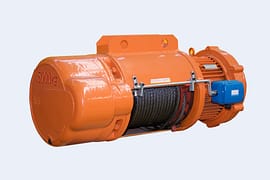
Electric Wire Rope Hoists
-
FEM Standard Wire Rope Electric Hoists
-
FEM Standard Electric Chain Hoists
-
Crane Trolley
-
Chain Hoists
-
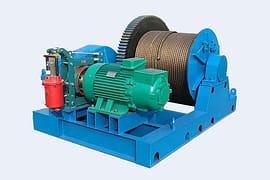
Electric Winch
-
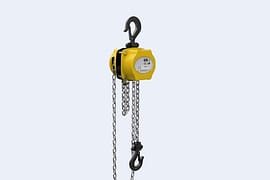
Manual Chain Hoists
-
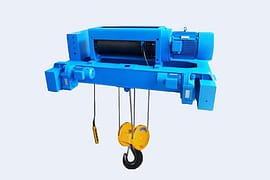
Double Girder Trolley Electric Hoists
-
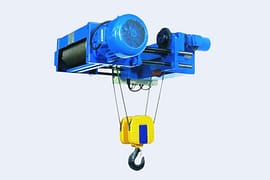
Low Headroom Wire Rope Electric Hoist
-
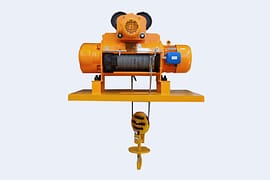
Electric Hoist for Molten Metal
-
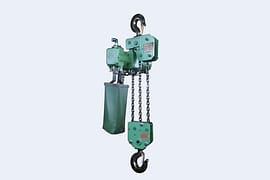
Pneumatic (Air) Chain Hoists
-
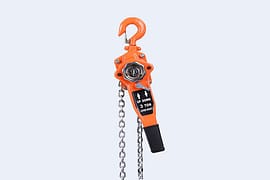
Lever Hoists
-
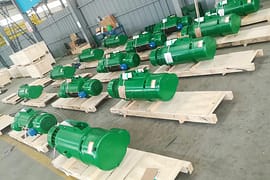
Electric Hoists
-
- Workstation Cranes
- Portable Gantry Cranes
- Explosion Proof Cranes & Hoists
- Special Cranes
- Port Cranes
- Electric Transfer Carts
-
Overhead Cranes
-
CRANE PARTS
- Crane Wheel Range
- Crane Grab Buckets
- Crane Tongs
- Crane Spreader
- Crane Drives
-
Crane Electrical Equipment
-
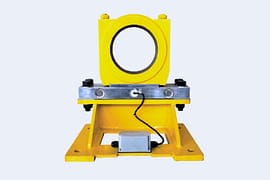
Overload Limiter
-
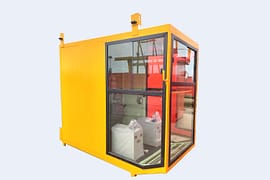
Crane Cabin
-
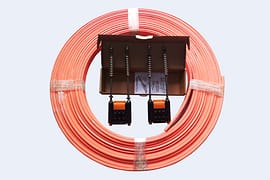
Crane Power Supply System
-

Explosion Proof Crane Radio Remote Controls
-
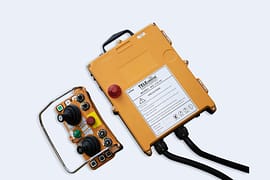
Joystick Type Crane Radio Remote Controls
-
Pushbutton Type Crane Wireless Remote Controls
-
Single-pole Insulated Conductor Rails
-
Enclosed Conductor Rails
-
Seamless Conductor Rails
-
Copperhead Conductor Rails
-
Overhead Crane Cables
-
- Other Cranes Parts
- ABOUT US
- CONTACT US
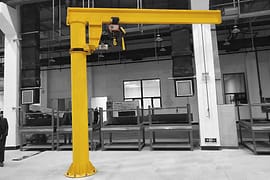
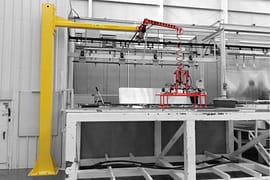
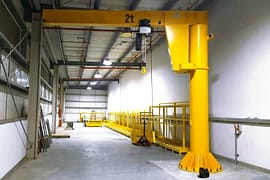
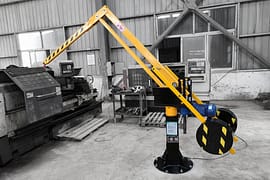
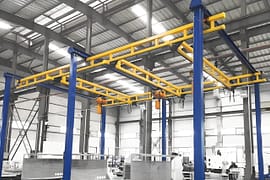
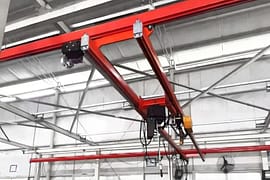
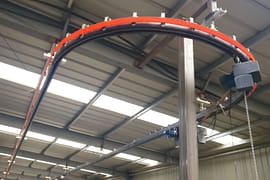
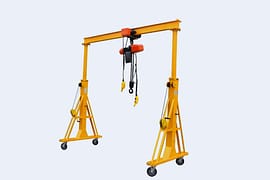

The Ultimate Guide to Industrial Jib Cranes: Types, Benefits, and Selection for 2026
Table of Contents
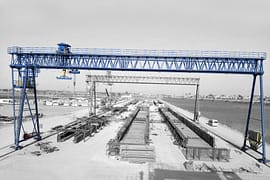
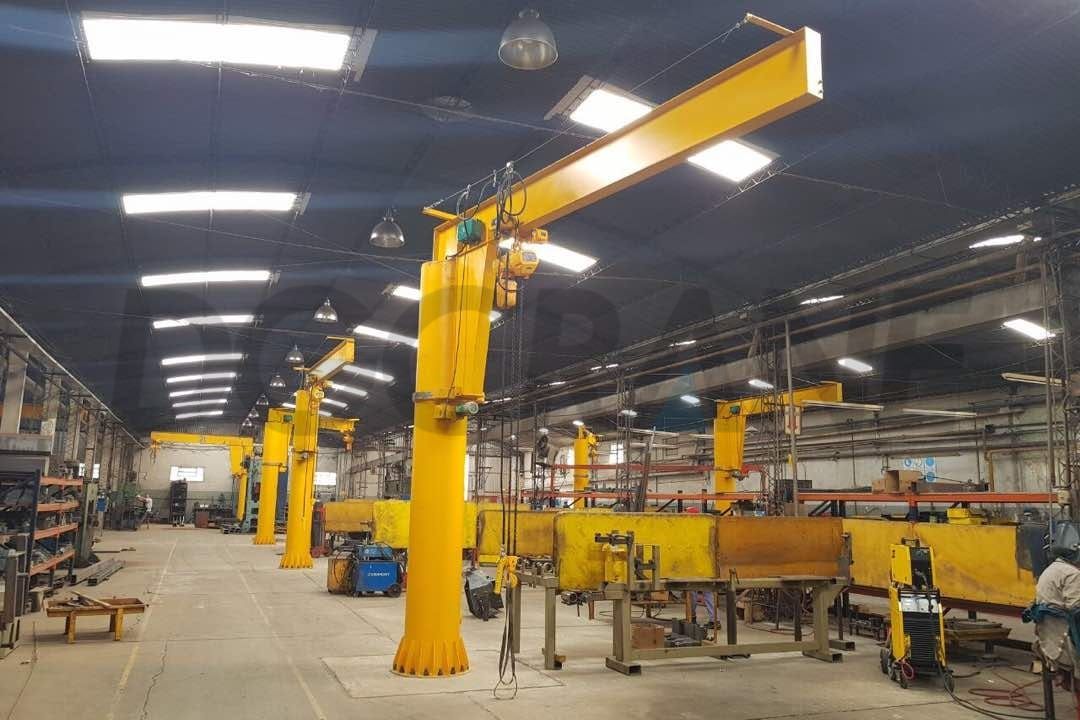
Industrial jib cranes play a vital role in modern industries such as assembly, warehousing, and heavy manufacturing, thanks to their spatial flexibility and cost efficiency. An industrial jib crane is characterized by its rotating arm, which pivots around a fixed point and can cover a semicircular or full circular working area. There are many different designs of industrial jib cranes to meet various applications and operational requirements. However, with so many types available, you may have the following questions before making a purchase:
- What is an industrial jib crane?
- What types of industrial jib cranes are available, and what are their differences and key features?
- How do you choose the right jib crane for your specific working conditions?
Common Types of Industrial Jib Cranes
A jib crane is a small- to medium-sized jib-type lifting device, mainly used for short-distance, high-frequency, and intensive lifting operations in factories, workshops, warehouses, and similar environments. Based on structural configuration, jib cranes can generally be classified into five types. Before selecting a jib crane, it is essential to understand the differences between these types.
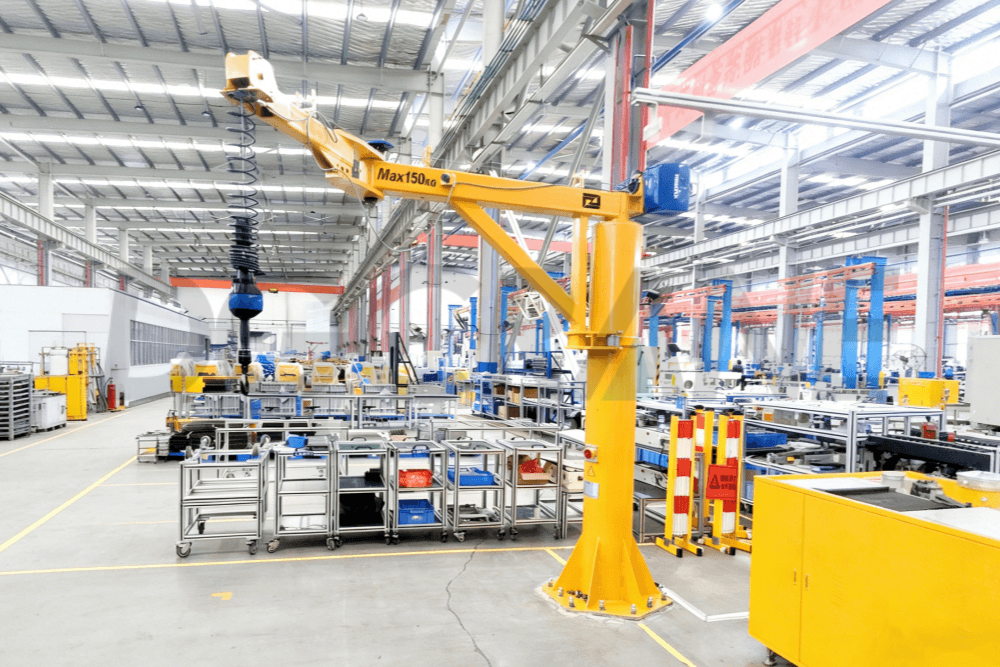
Free Standing Jib Crane
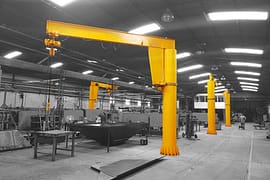
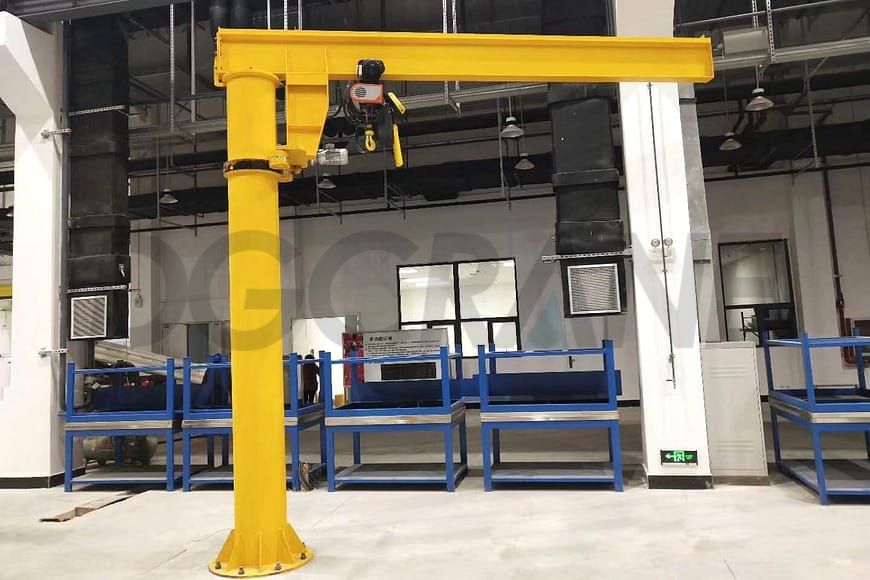
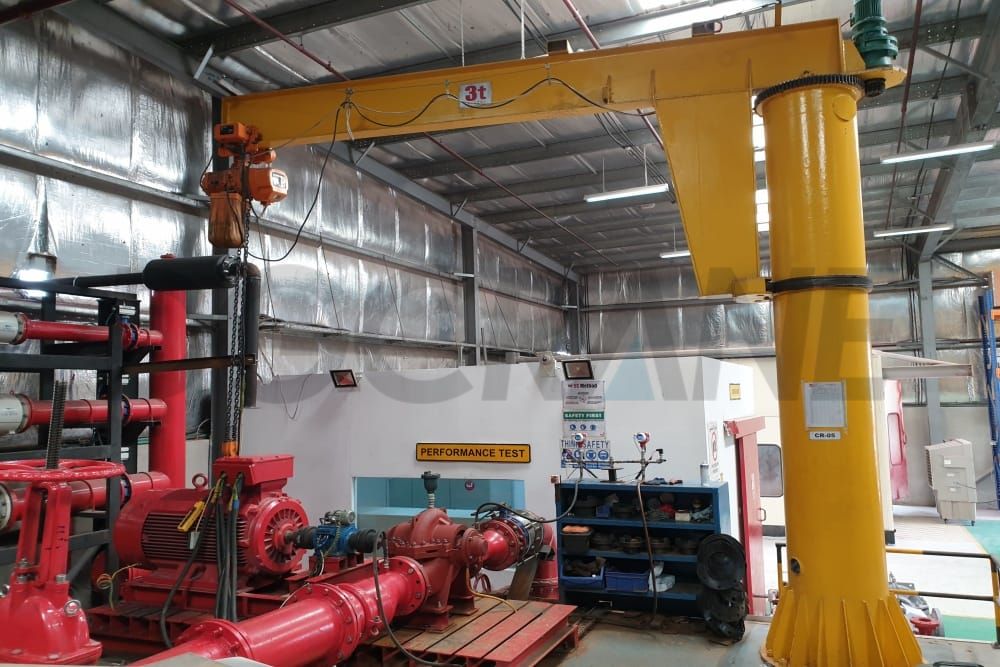
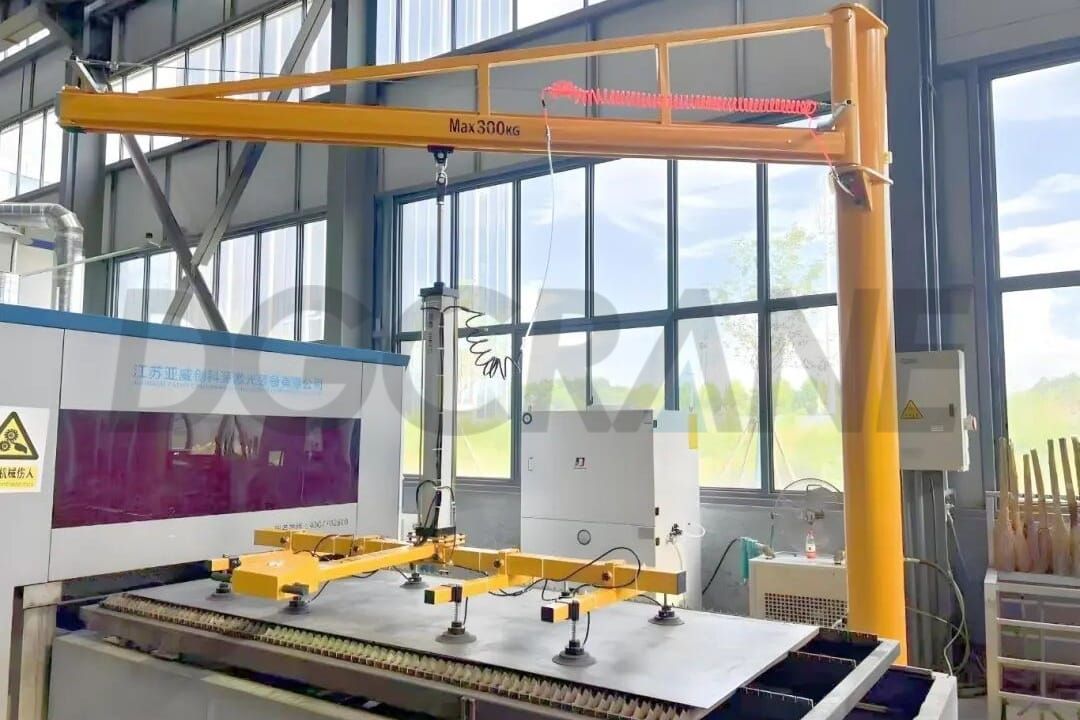
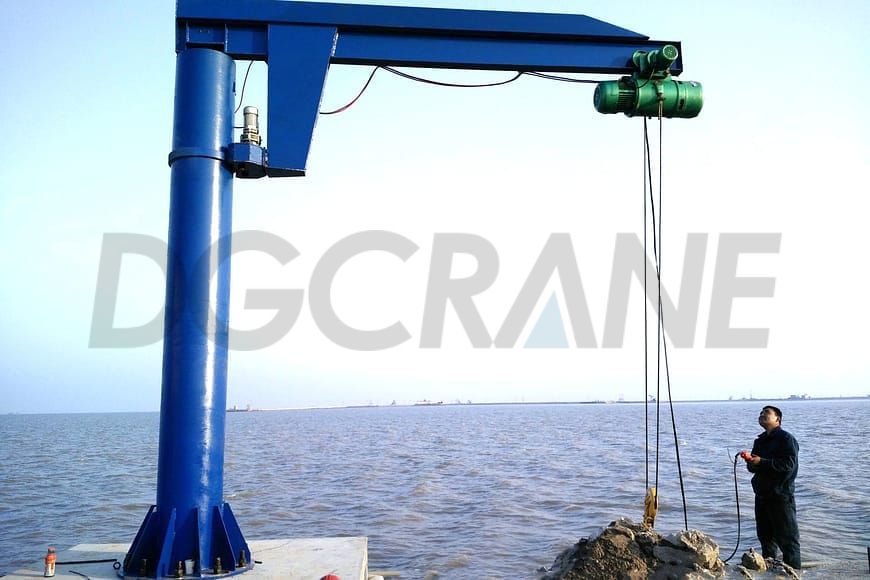
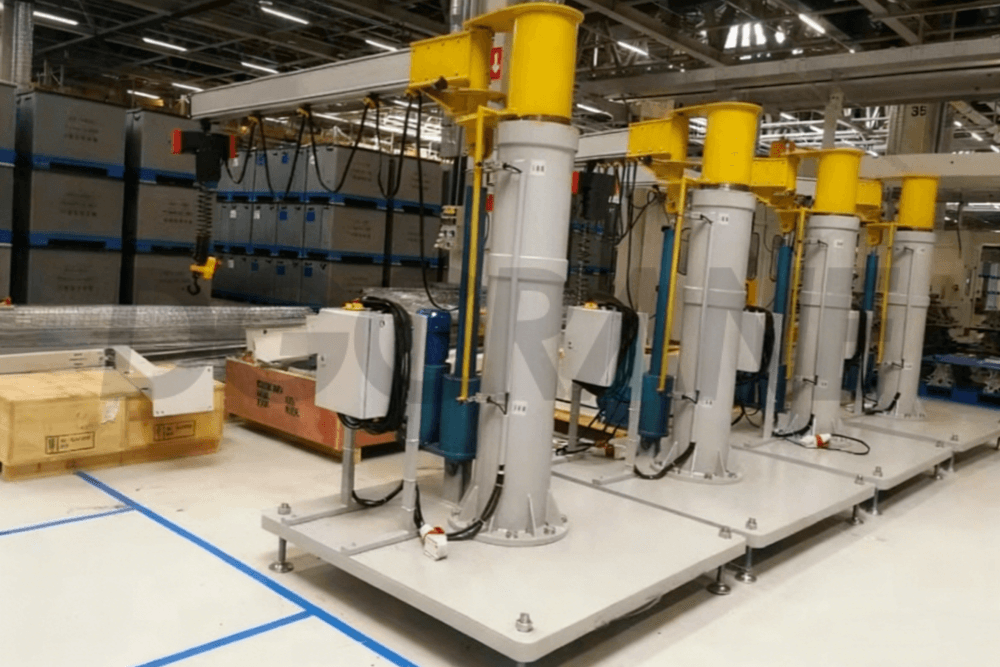
A free-standing jib crane is an independent, floor-mounted light-duty lifting device that is anchored to a concrete foundation and does not rely on any building structure for support. This design allows the crane to be precisely positioned at any production workstation, enabling independent material handling at the workstation level.
Pros
- High structural rigidity and strong load capacity; standard column-mounted jib cranes can handle loads of up to 10 tons
- 360° × n full-range rotation, providing wide area coverage
- Independent of building structures, with no need for secondary reinforcement or modification to the facility; suitable for any open workspace
- Flexible production line layout, capable of operating independently within the workshop
- Simple structure with low maintenance requirements
Cons
- Relatively higher initial cost due to the additional column and structural steel
- The base occupies floor space and cannot remain floor-free like wall-mounted jib cranes
- Installation is relatively complex and requires high foundation strength
- High requirements for installation levelness; if anchor bolts are unevenly embedded, the long jib arm may experience “drifting” (self-sliding) at the end
Industrial Jib Crane Application Scenarios
Wall-mounted Jib Crane
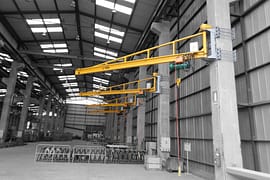
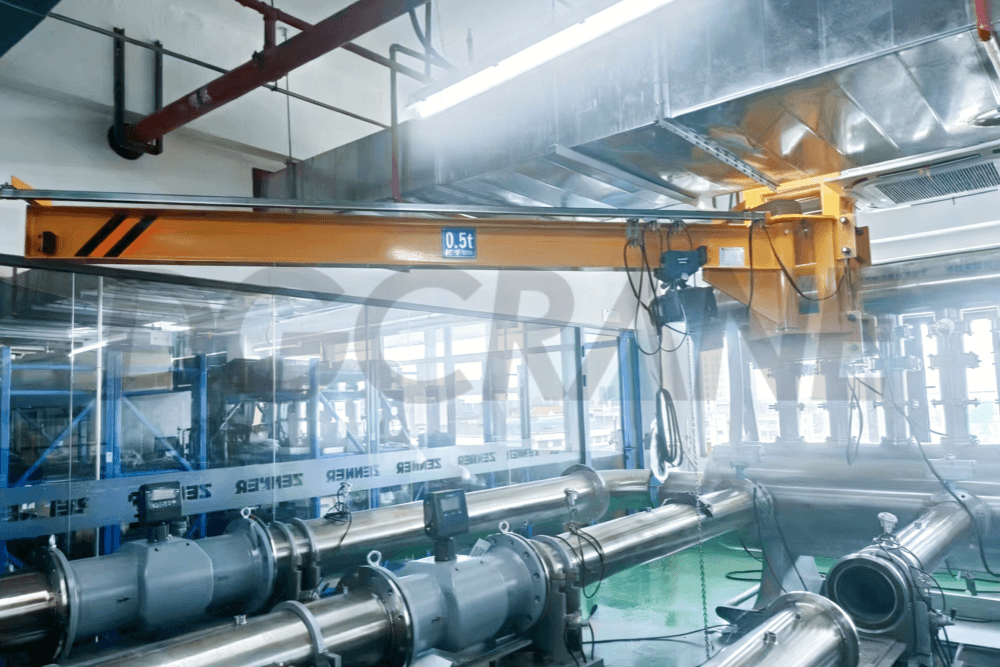
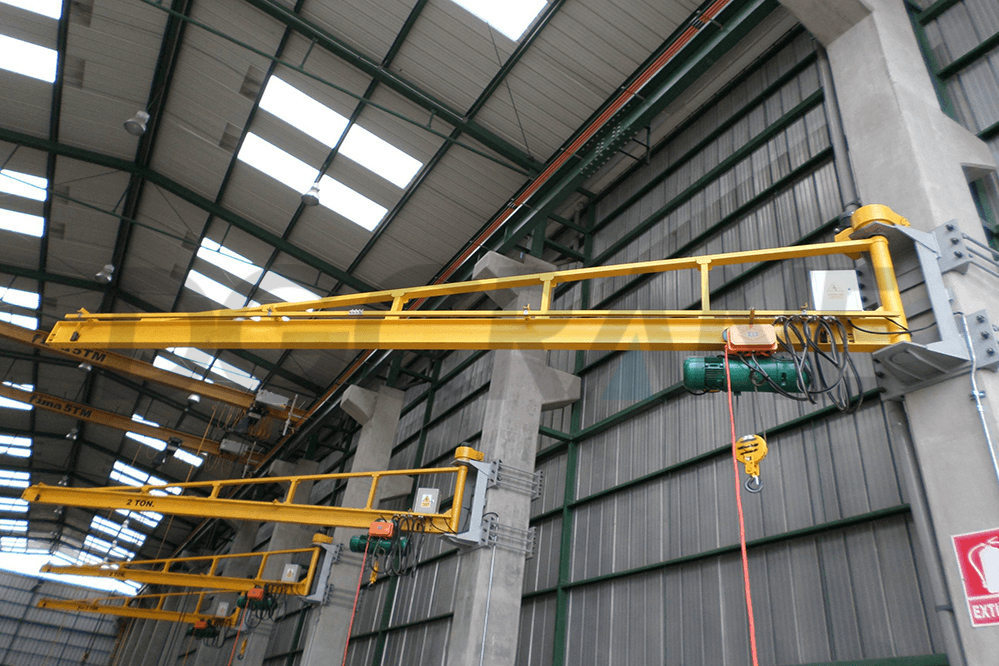
A wall-mounted jib crane is a light-duty lifting device fixed to a wall or building column. It is designed to transfer lifting moments through the main building structure, providing efficient material handling within a 180° semicircular working area while achieving zero floor-space occupation.
Wall-mounted jib cranes are specifically intended for workstations along the edges of production lines. By utilizing vertical space, they help relieve the workload of main overhead cranes and reduce material-handling bottlenecks, thereby improving overall production efficiency.

Pros
- Zero floor-space occupation, freeing up aisles and work areas; ideal for narrow workshops with frequent traffic
- Lower overall cost, making it suitable for budget-conscious small manufacturers or specific workstations
- Simple and convenient installation, typically secured using through-bolts or clamp brackets
- Lifting height can be freely determined according to the required hoisting height
Cons
- Limited slewing range; due to structural constraints, rotation is restricted to 180°
- Lower lifting capacity, limited by wall or column load-bearing capability; typically under 3 tons
- Installation on building columns requires high structural capacity and must be verified through structural calculations
- Constrained by existing building conditions and can only be installed along the sides of the workshop
Industrial Jib Crane Application Scenarios

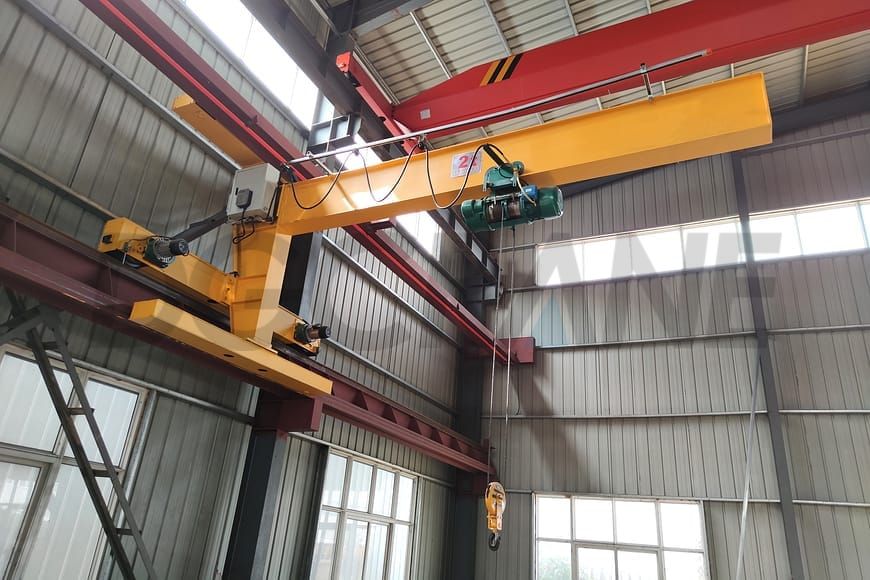
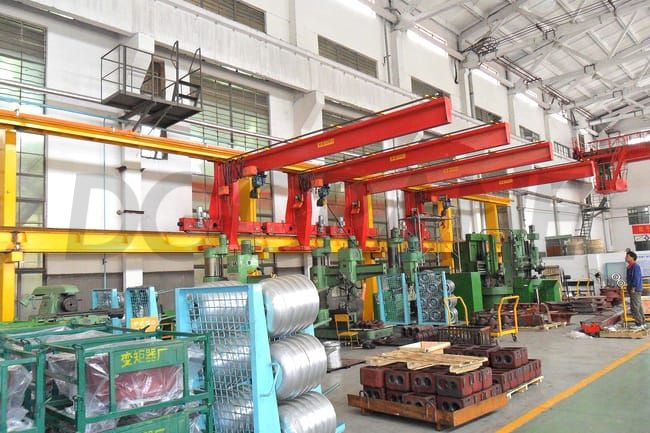
Wall-Travelling Jib Crane
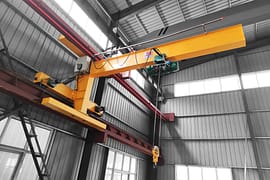
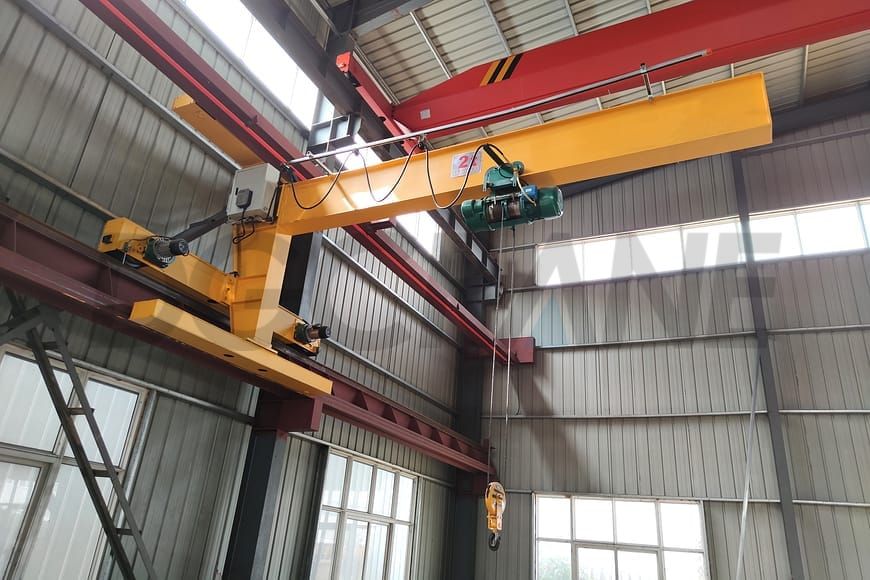
A wall-travelling jib crane is a lifting unit that runs along a longitudinal rail installed on the side walls or building columns, enabling rectangular area coverage. It allows an independent operating zone to be created beneath the main overhead crane without interference. By supporting efficient multi-workstation coordination, it maximizes productivity while completely freeing up floor space.
Pros
- High lifting capacity
- Significantly expands the operational range; a single crane can serve an entire row of wall-side workstations
- Rail is mounted overhead, completely freeing up floor space
- Operates beneath the main overhead crane without interference, enabling layered use of vertical space
Cons
- Complex installation with high construction requirements due to the need for rail mounting
- Strict building requirements for installation
- In addition to the crane itself, the rail structure and electrification system increase the overall budget
Industrial Jib Crane Application Scenarios
Articulating Jib Crane
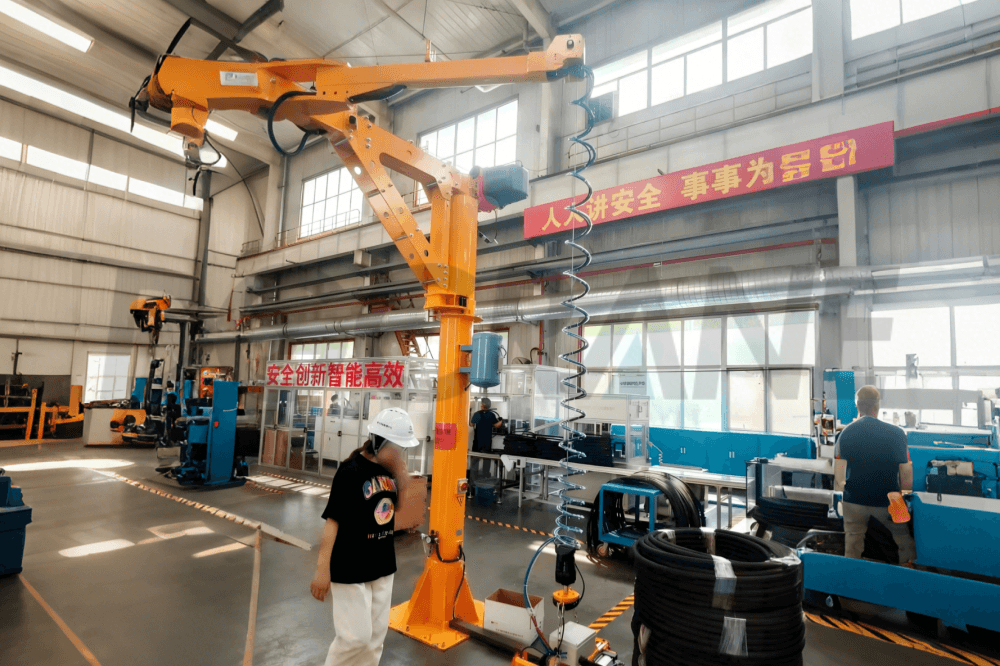
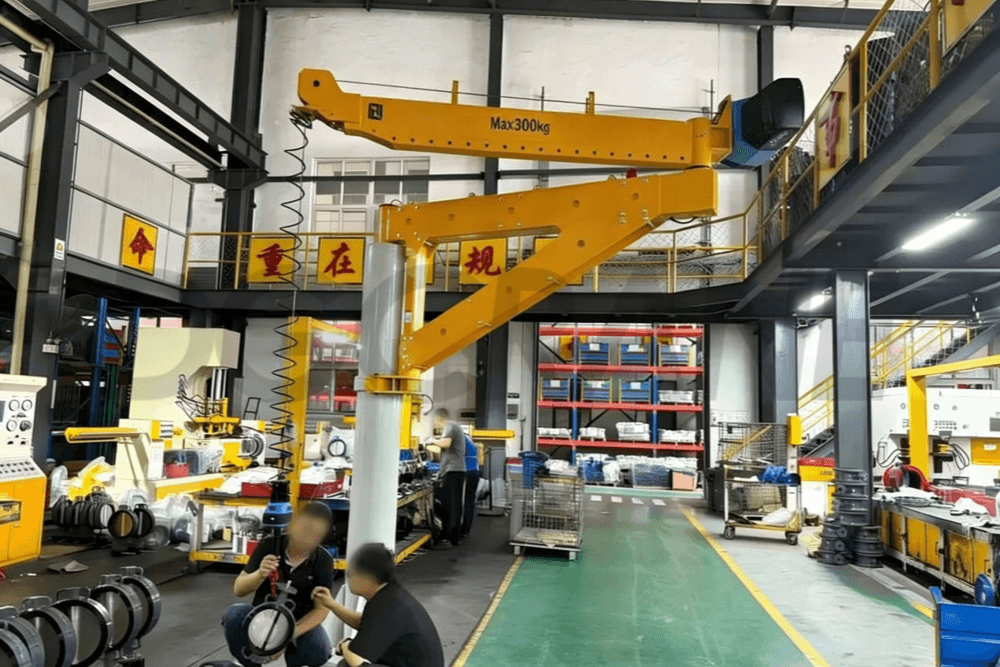
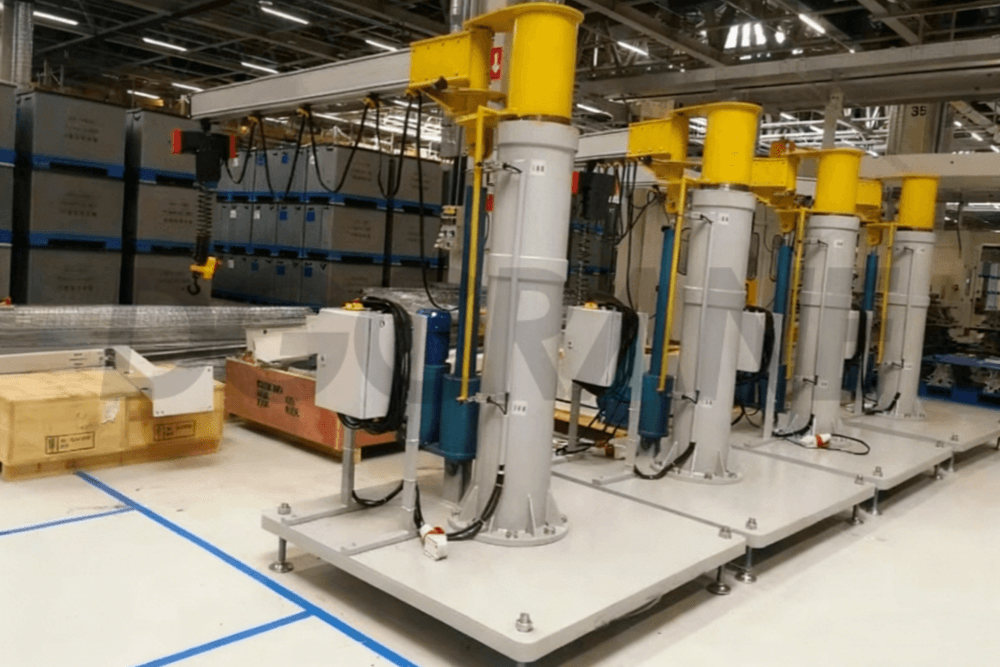
An articulating jib crane is a precision material-handling solution that features a dual-joint configuration with a main arm and a secondary arm. By utilizing two independent rotational pivot points, it enables non-linear coverage that can maneuver around columns, piping, or equipment obstructions.
This design minimizes the operational blind spots commonly found near the mast of traditional straight-arm jib cranes, allowing the crane to reach into tight spaces or inside machinery for high-frequency loading, unloading, and assembly operations.
Pros
- Extremely high flexibility, capable of maneuvering around obstacles and reaching otherwise inaccessible indoor areas
- The outer arm is typically lightweight with highly flexible joints, allowing smooth operation and making it ideal for high-frequency, light-duty assembly tasks
- Flexible installation options, including free-standing, wall-mounted, or ceiling-mounted (track-mounted) configurations
- Well suited for precision workshops with limited headroom and dense obstructions
Cons
- Lower lifting capacity; due to structural limitations, the rated load is typically below 800 kg
- More complex design, resulting in higher cost
- Additional rotational bearings increase maintenance requirements, including regular inspection, lubrication, and tightening of joints
Industrial Jib Crane Application Scenarios
Portable Mobile Jib Crane
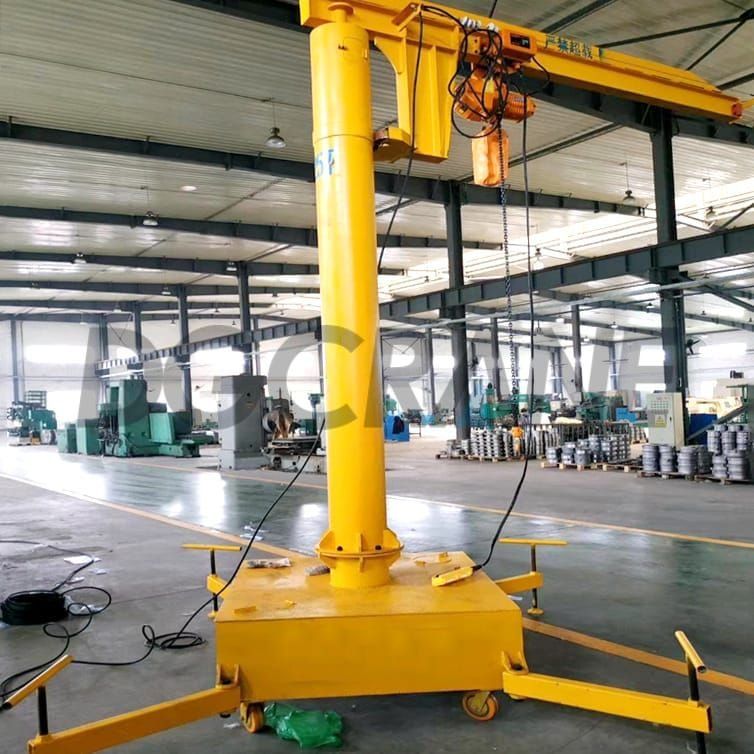
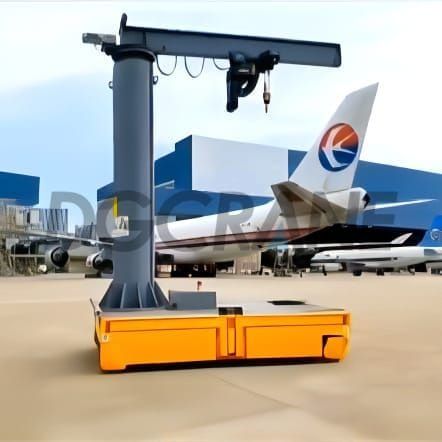
A portable jib crane is a local lifting solution that uses a counterweighted base instead of anchor bolts, eliminating the need for foundation construction. This design allows the crane to be quickly relocated between workstations using a forklift and supports plug-and-play operation.
With extremely low on-site installation costs and a very short commissioning cycle, portable jib cranes provide a flexible mobile material-handling solution for production lines that require frequent layout changes or dynamic adjustment.
Pros
- High mobility; can be relocated using a forklift, making it ideal for dynamically adjustable production lines
- No foundation anchoring required, eliminating the ground and foundation requirements associated with column-mounted jib cranes
- Simple installation; only bolted assembly, leveling, and electrical connection are needed before operation
Cons
- Limited by overturning moment; lifting capacity is typically below 1,000 kg
- Relatively short jib length, usually within 4 meters
- To counterbalance the load at the jib end, the base is filled with counterweights, resulting in a larger floor footprint
Industrial Jib Crane Application Scenarios
How to Choose the Right Industrial Jib Crane: A 4-Step Selection Process
When selecting a industrial jib crane, you need to consider not only your current lifting requirements but also the building's structural limitations and potential future expansions. Follow these five key steps:
Step 1: Define Your Capacity (Working Load Limit)
The lifting capacity is the primary parameter. You should account for both the heaviest load and the weight of the lifting device (e.g., hoist, magnet, or clamp).
- Safety Margin: Choose a model slightly above your maximum load. For example, if you frequently lift 450 kg, a 500 kg or 1 ton crane is safer.
- Impact Factor: Consider dynamic loads during lifting startup; allow a suitable safety factor.
Expert Tip: Never operate at full load. Selecting a rated capacity 15–20% higher than the maximum requirement extends equipment life and ensures safety.
Step 2: Determine the Area of Coverage (Span & Rotation)
Decide whether you need to cover a circular area or specific workstations.
- Span (S): The length of the jib. Note that the “effective reach” is usually slightly less than the total arm length, as the trolley cannot reach the base of the mast.
- Rotation Degree:
- 360°: Choose a freestanding column-mounted jib crane.
- 180°: Choose a wall-mounted jib crane.
- Double-jointed: If you need to navigate around obstacles, select an articulating jib crane.
Step 3: Measure Your Height Constraints
Height determines lifting efficiency and compatibility with your building.
- Height Under Boom (HUB): Distance from the underside of the jib to the floor. Ensure that after accounting for the hoist and attachment height, your load can still be lifted safely.
- Overall Height: Make sure the top of the jib crane won't collide with lighting, piping, or existing overhead cranes.
Step 4: Power Supply and Control Options
- Manual vs. Motorized: Small loads (<1 ton) and short travel distances can be manually operated.
- Control Method: Operation is typically via a pendant control (button handle) or remote control.
This systematic approach ensures you select an industrial jib crane that meets both operational and safety requirements while maximizing efficiency and flexibility.
Quick Selection Comparison Table of Industrial Jib Crane
| Types | Free-Standing Jib Crane | Wall-Mounted Jib Crane | Wall-Travelling Jib Crane | Articulating Jib Crane | Portable / Mobile Jib Crane |
| Illustration | 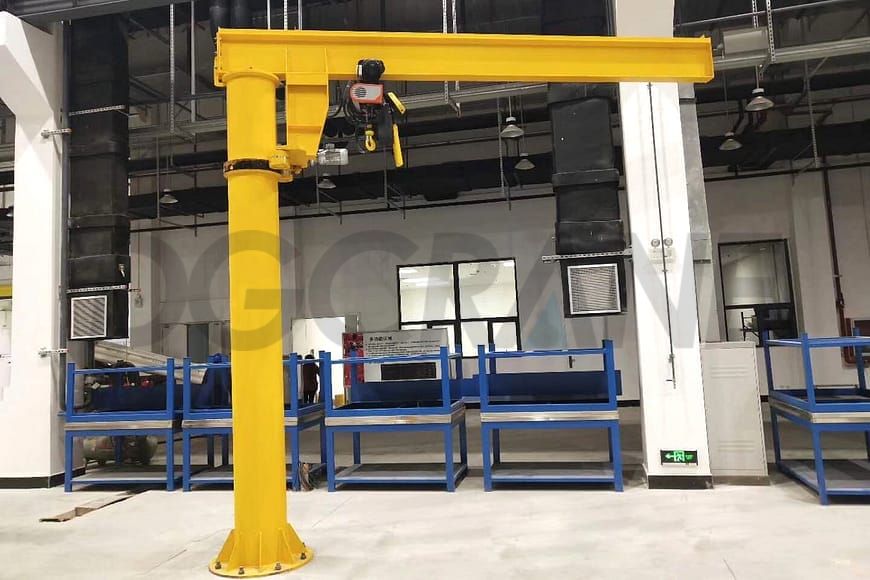 |
 |
 |
 |
 |
| Max Load Capacity | 16 t | 5 t | 5 t | 0.5 t | 1 t |
| Max Jib Length | 12 m | 6 m | 7 m | 6 m | 4 m |
| Installation Method | 1. Chemical anchor bolts 2. Embedded bolts |
Fixed to wall or column with clamps/through-bolts | Rail installed on building columns | Chemical anchor bolts | Counterweighted basesimple installation |
| Rotation Angle | n × 360°; motorized rotation available | Maximum 180° | No rotation (moves along rail) | Main arm: 360° / Secondary arm: 270° | n × 360° |
| Hoisting Device | Electric chain hoist / Electric wire rope hoist | Electric chain hoist / Electric wire rope hoist | Electric wire rope hoist | Electric hoist / Intelligent servo electric hoist | Electric chain hoist / Manual chain hoist |
| Control Method | Pendant / Remote control | Pendant / Remote control | Pendant / Remote control | Gravity-sensing handle / Pendant | Pendant / Remote control |
| Key Features | Full 360° rotation High load capacity (up to 16 t) |
Saves floor space, ideal for workstation edges | enables longitudinal coverage along wall | Two rotating arms can maneuver around obstacles |
Highly mobile Can be relocated using a forklift |
Every workshop or factory has a unique structure and set of operating conditions. If you're still uncertain after following the five-step selection process, or if you face special space constraints, don't worry.
DGCRANE's team of experienced engineers has delivered custom lifting solutions for over 100 countries worldwide, ensuring your industrial jib crane is perfectly tailored to your facility and workflow.

Zora Zhao
Expert in Overhead Crane/Gantry Crane/Jib Crane/Crane Parts Solutions
With 10+ years of experience in the Crane Overseas Export Industry, helped 10,000+ customers with their pre-sales questions and concerns, if you have any related needs, please feel free to contact me!
WhatsApp: +86 189 3735 0200
Email: zorazhao@dgcrane.com
Contact Details
DGCRANE is committed to providing the professional Overhead crane products and relavent service. Exported to Over 100 Countries, 5000+ Customers Choose Us, Worth to be Trusted.
Get In Touch
Fill out your details and someone from our sales team will get back to you within 24 hours!
Subscribe to our newsletter
The latest DGCRANE price list, news, articles, and resources.